Mahjong Solitaire Game / How to play Mahjong Solitaire
How to play Mahjong Solitaire
To play Mahjong Solitaire you remove tiles from a stacked layout two at a time. The two tiles must match, and both must be free. A tile is free when nothing lies on top of it and at least one of its two long sides, left or right, has no tile against it. When every tile is gone the deal is won. You can try it straight away in the Mahjong Solitaire game on the home page.
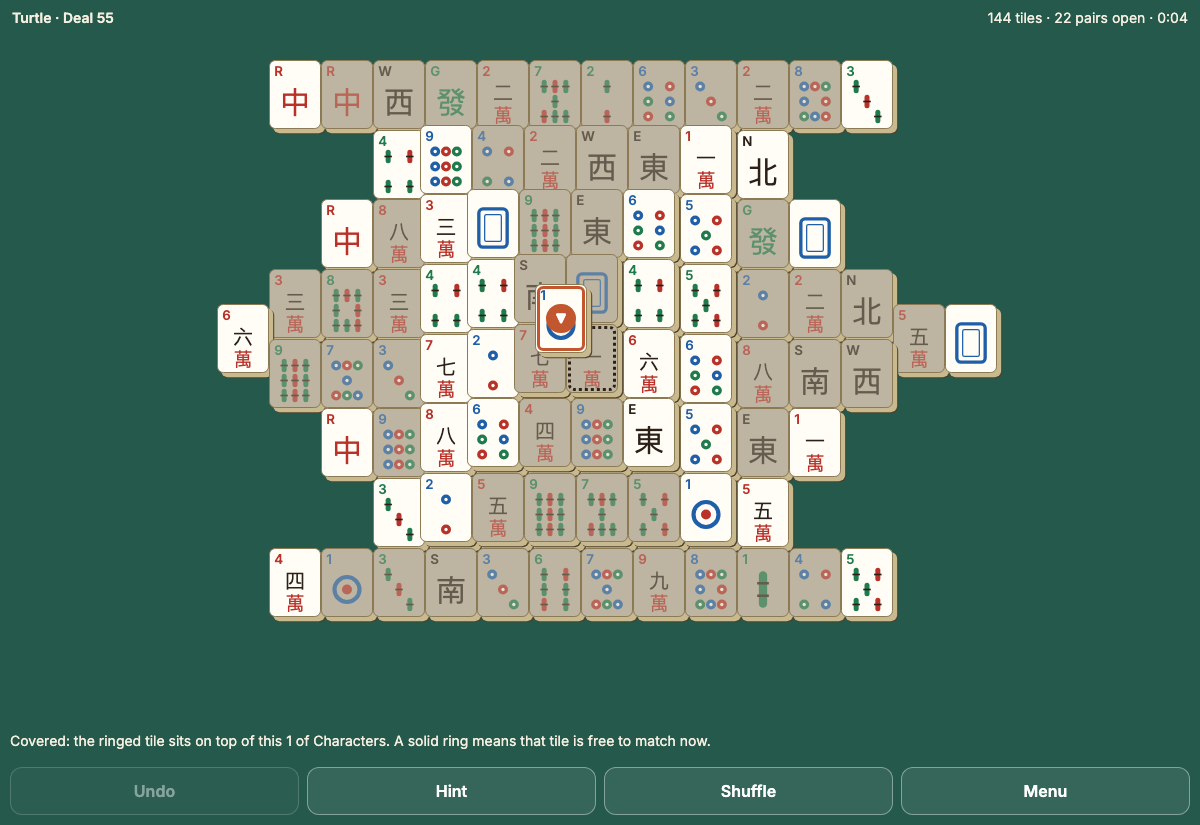
The free-tile rule, case by case
Almost every question about how to play Mahjong Solitaire comes back to this rule, so it is worth reading slowly.
- Nothing on top. A tile in a higher layer blocks every tile it touches from above, even when it overlaps only a corner. The single tile on the peak of the Turtle rests on four tiles and blocks all four.
- One side open. Look left and right in the same layer. If both neighbours are present, the tile is boxed in. If either is missing, that side is open.
- Above and below do not count. A tile can have neighbours on the far and near edges, in the rows behind and in front of it, and still be free.
- Half-step neighbours count. Some layouts shift a tile half a row. A tile that touches half of your tile's side blocks that side.
In the game on this site a tile that is not free is shaded. Tapping it rings the tiles in the way. A down arrow marks a tile on top. Arrows pointing inward mark the left and right neighbours. A solid ring tells you that blocker is itself free, so matching it is the direct way to open your tile. A dashed ring tells you the blocker is stuck too, and you can tap it to follow the chain one step further.
The tile set
A full set has 144 tiles in 42 designs.
| Group | Designs | Copies of each | Tiles |
|---|---|---|---|
| Dots | 1 to 9 | 4 | 36 |
| Bamboo | 1 to 9 | 4 | 36 |
| Characters | 1 to 9 | 4 | 36 |
| Winds | East, South, West, North | 4 | 16 |
| Dragons | Red, Green, White | 4 | 12 |
| Flowers | 4 different pictures | 1 | 4 |
| Seasons | 4 different pictures | 1 | 4 |
Suited and honour tiles pair only with an identical tile, so each design gives two pairs. Flowers and seasons are the exception: any flower pairs with any flower, and any season with any season.
The tiles here are drawn with a small index in the top left corner so you do not need to read Chinese numerals. Dots, Bamboo and Characters carry their number. Winds carry E, S, W or N. The Red Dragon carries R and the Green Dragon G; the White Dragon is the empty blue frame. Flowers show a pink bloom and seasons a sun, each numbered 1 to 4.
Layouts on this site
| Layout | Tiles | Layers | Size | Offered on |
|---|---|---|---|---|
| Turtle | 144 | 5 | 15 tiles wide, 8 deep | Tablets and desktops |
| Pagoda | 78 | 4 | 7 by 7 | Any screen |
| Twin Pillars | 72 | 3 | 7 by 7 | Any screen |
Turtle is the classic shape: a wide base, a stack of four more layers narrowing to one tile, one tile jutting out on the left and two on the right. It uses the complete set.
Pagoda is a seven-by-seven square with three smaller squares stacked on it, each shifted half a tile so that it rests across the joins of the layer below. It uses 17 designs four times, one design twice, and the flowers and seasons.
Twin Pillars is two three-wide blocks joined by a short bridge, each with a narrower block on top. It uses 16 designs four times plus the flowers and seasons.
The menu greys out a layout when its tiles would be too small to tap on your screen. Choosing a layout starts a new deal.
Controls
- Tap or click a free tile to select it, then tap its match. Tap the selected tile again to let go of it.
- Hint rings the open pair that would free the most tiles.
- Undo puts back the last pair, and keeps going back to the start of the deal. It also takes back a shuffle.
- Shuffle deals the remaining tiles again over the same places, in an order that can be cleared.
- Menu holds New deal, Restart this deal, the layouts, the shading switch and the six-tile practice board.
- Keyboard: H hint, U undo, S shuffle, M menu, Esc to close the menu or drop a selection.
How a deal ends
You win when the board is empty. The game shows your time and how many hints and shuffles you used, and keeps your best time for each layout. There is no way to lose on the clock: the timer only counts up, and it stops while the menu is open or the tab is in the background.
If no pair is open, nothing is lost. Shuffle or undo and carry on. For how to avoid getting there, see the Mahjong Solitaire strategy page.